

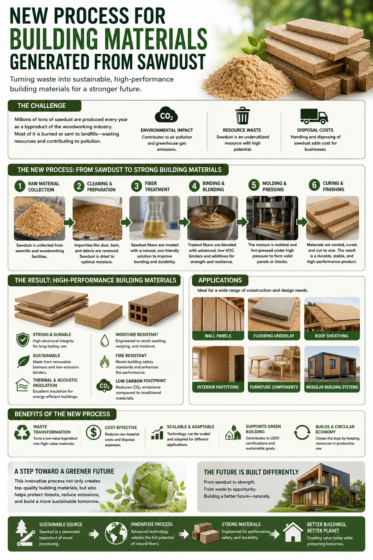
 Being able to make use of hardwoods for building of all sort has been a huge part of what has allowed humans to develop civilizations. For providing shelter for people it’s fair to say that wood has been absolutely invaluable, and here in Canada the forestry industry is one of the biggest ones because of the demand that comes from that reality and the fact we have huge expanses of forests across the country. Using wood for construction means that it needs to be cut, and in doing so plenty of the fibre becomes sawdust. Our specialty is dumpster rentals for Trenton and Colborne, but like anyone we’ve taken a saw to wood plenty of times before too.
The difference is being we never had the scientific slant required to be able to identify that sawdust can actually be repurposed, and that it doesn’t always have to be swept into a pan and poured into the trash can. Fortunately there are smarter folks in Switzerland that have seen a way to take that sawdust and give the wood fibres a second life by reconstituting them into viable building materials.
This is very beneficial, as wood tends to be expensive and making as much use of it as possible is going to mean getting maximum value from it. We don’t see much of any dust at all with our waste disposal service for Belleville and area, but offcuts from wood that could be used in some way are in there from time to time.
Which is fine, as provincial transfer stations here in Ontario don’t have any trouble with handling wood waste but anything that can increase the extent to which wood is used for construction stands to benefit all of us living in highly-developed urban areas. This new recyclable wood composite is already being used in Europe, and it’s quite likely the we’ll see this new technology being utilized here in Canada and the USA before long.
This is the sort of subject that will always grab attention for people like us who are in the waste management and recycling industry, even though what we’re talking about here is more of material repurposing.
All of this stuff is tied in together. In the bigger picture it’s about minimizing improperly processed waste materials, and making use of what does’t necessarily have to become waste after it becomes a byproduct of the primary utilization. So what we’ll do with this month’s blog entry is look at how sawdust can be turned into new composite building boards.
Watermelon Connection
This promising new development has been made by researchers at ETH Zurich and Empa and what they’ve done is develop a process that can convert sawdust into a recyclable composite The process uses a mineral called Struvite, which is a crystalline form of ammonium magnesium phosphate and primarily known for its fire protection properties. The challenge with using it up until now had been the difficulty combining Struvite with sawdust particles because of its crystallization behaviour.
The key to being able to do this is connected to a long-time favourite summertime fruit for people. We’re talking about watermelons, and the researchers found that an enzyme extracted from watermelon seeds would allow them to control the crystallization of the mineral precursor – something called Newberyite. This is the furthest thing from disposal bin rentals for Campbellford or renting a dumpster in Cobourg, but it’s interesting to become aware of how this enzyme can be used to creates large crystals from sawdust that have a firmness and structural potential to them when put together in large numbers.
How that happens is these large crystals fill the cavities between the sawdust particles and bind them together firmly. The material is then compressed for a few days, and then removed from the mould and dried at room temperature. It’s stronger under compression perpendicular to the grain than the original spruce timber, and it also has a fire-resistant quality to it. Which of course is also preferable for a building material and especially if it’s going to used for residential or commercial building in Canada. The fire resistance also make this new material especially good for use with internal fittings.
The mineral breaks down when heated and it then releases water vapour and ammonia. Heat from the surrounding environment is absorbed too, and this produces a cooling effect which will suppress any fire rather than promoting it increasing in intensity. The non-combustible gases that are released also displace the air, hindering the fire from spreading further and causing the material to char more quickly.
Equal of Cement-Bonded Particleboards
For a long time the construction-industry standard for internal fittings has been cement-bonded particleboard, and one of the things that is really lauded with this new sawdust-sourced building material is that it has same fire protection class as conventional cement-bonded particleboards. The drawback with cement-bonded boards is that they contain 60 to 70% cement by weight, and so they’re heavy and have a larger carbon footprint because of the high level of energy involved in cement production.
Struvite sawdust boards are much lighter as they contain only 40% binder, and another huge plus is that they’re easier to recycle once their service life comes to an end. It need not end us waste either, as unlike cement-bonded particleboards the Struvite sawdust board can be broken down into its individual components. This is done by breaking it up mechanically in a grinder and heating it upwards of 100°C so ammonia is released and the sawdust can then be sifted out.
Newberyite can then be mixed with sawdust again to form more of these Struvite composites. Plus the use applications don’t end there – it can also be used as a natural fertilizer because it releases the bound phosphorus that plants need for more slow and controlled growth.
The only aspect that may be slowing the rollout and incorporating of this new building material technology is the fact that Struvite is relatively expensive compared to polymer binders or cement. But there may be a counter to that expensiveness as Struvite accumulates in large quantities in sewage treatment plants. So it may be that another form of ‘waste’ may actually be a legit source of what’s needed to create plenty of this new recycled-source building material and bring down the cost of it.
Call Load n’ Lift first for Trenton and Colborne area dumpster rentals every time you had large-scale waste disposal needs. Our trucks will deliver roll-off bins, and they are much better designed for use on job sites and can be placed and removed much more easily with less chance of damaging the ground under them.
We are Ontario Ministry of Environment approved, and our mini-bin system makes it possible to get smaller dumpsters into challenging locations that other providers may struggle with. We are your best choice for Madoc and Marmora dumpster rentals too and we can usually deliver a bin the same day you call for one.
Load-N-Lift Disposal — family-owned bin & dumpster rental across Eastern Ontario since 2007.
Related: our bin rental services · all areas we serve.
Call 877-355-5623 for up-front pricing and same or next-day delivery.